
East Baton Rouge Address Eras
A sound trail begins by asking which record can speak for the year in question. East Baton Rouge Parish has an unusually deep archive, but the whole run is not in one online search. The Clerk preserves original parish records and indexes from 1782, while its tax rolls begin in 1872. Modern assessment and deed tools lead into those older files. Directories and maps fill another role: they connect a dated street label to a household, business, church, or subdivision.
| Source | Years or era | Where held | What it can show |
|---|---|---|---|
| Parish and deed indexes | From 1782 | EBR Clerk Archives and Recording | Recorded parties, instruments, land descriptions |
| Tax rolls | From 1872 | EBR Clerk Archives | Dated assessment names and land clues |
| Baton Rouge city directories | Selected years from 1888 onward | EBRPL, digital archive, State Archives | Names, work, and residence entries |
| Historic maps | 1885; index 1963-1985 | Digital Archive and Clerk | Old streets, lots, churches, subdivisions |
| Obituary indexes | 1940s-1991 | EBR Parish Library | Family, death, church, funeral clues |
Use the newest reliable source first. Then move backward one dated link at a time. An online miss is not the end. Request an in-person index check, call Recording at (225) 389-3985, contact Archives at (225) 389-3988, or submit a narrow records request under Louisiana Public Records Law.
East Baton Rouge Deed Trail
The East Baton Rouge Parish Assessor supplies the current assessment number, parcel mapping number, physical address, legal description, subdivision, lot, block, ownership, and transfer tabs. These are tax-administration facts, not a title certificate. Confirm each transfer through the Clerk Recording Department, where conveyance indexes use vendor and vendee rather than only seller and buyer.
- Find the parcel in SmartCAMA and record its assessment number, legal description, subdivision, lot, and block.
- Locate the latest purchase in ClerkConnect or ask Recording to search the vendee index. Save the Original and Bundle numbers and recordation time.
- Read the instrument for the vendor. Search that party as a prior vendee to find the earlier acquisition.
- Repeat the sequence. Track corrections, donations, partitions, judgments of possession, tax sales, and map references as well as sales.
- When online access stops, take the names, dates, legal description, and instrument numbers to the Clerk counter or Archives.
- Grantor or vendor
- The party transferring an interest in land.
- Grantee or vendee
- The party receiving the recorded interest.
- Chain of title
- The linked series of recorded transfers for one tract.
- Legal description
- The lot, block, subdivision, or survey wording that can survive an address change.
ClerkConnect is subscription based. Research lists $20 for 24 hours, $65 for 30 days, and $780 for 12 months, with separate print and certification charges. Free in-person inspection is the fallback when an online pass is not useful.
Previous Residents Since 1782
The East Baton Rouge Clerk Archives reaches into Spanish West Florida and territorial-era records. That depth is valuable, yet it requires care. A record before Louisiana statehood may describe the same ground under another jurisdiction label. Archives also holds notarial bundles and civil, family, probate, criminal, judicial, and bankruptcy material that can explain a transfer or inheritance.
For an archive request, give a surname, record series, approximate span, parish, and any page or index clue. Ask whether a copy or staff-assisted search is available. The Louisiana State Archives adds Clerk microfilm, including Spanish West Florida records from 1782-1810, civil records from 1871-1986, and other runs. A focused request works better than asking for every file about a person.
Note: An archive start date shows the collection's depth, not proof that every record series survives without gaps.
Maps Restore Past Baton Rouge Addresses
Street text often fails before the land trail does. A house number may change, a parcel may split, or a subdivision name may replace an older place name. The Clerk's 1963-1985 map index is divided by year bands and alphabet ranges, making it a practical key before requesting a map-book record.
The successful capture below shows that historical map-index source.
Record the relevant range and year before contacting the Clerk, then inspect the indexed map itself.
The 1885 Official Map of Baton Rouge adds streets, churches, public buildings, and subdivisions from an earlier city.
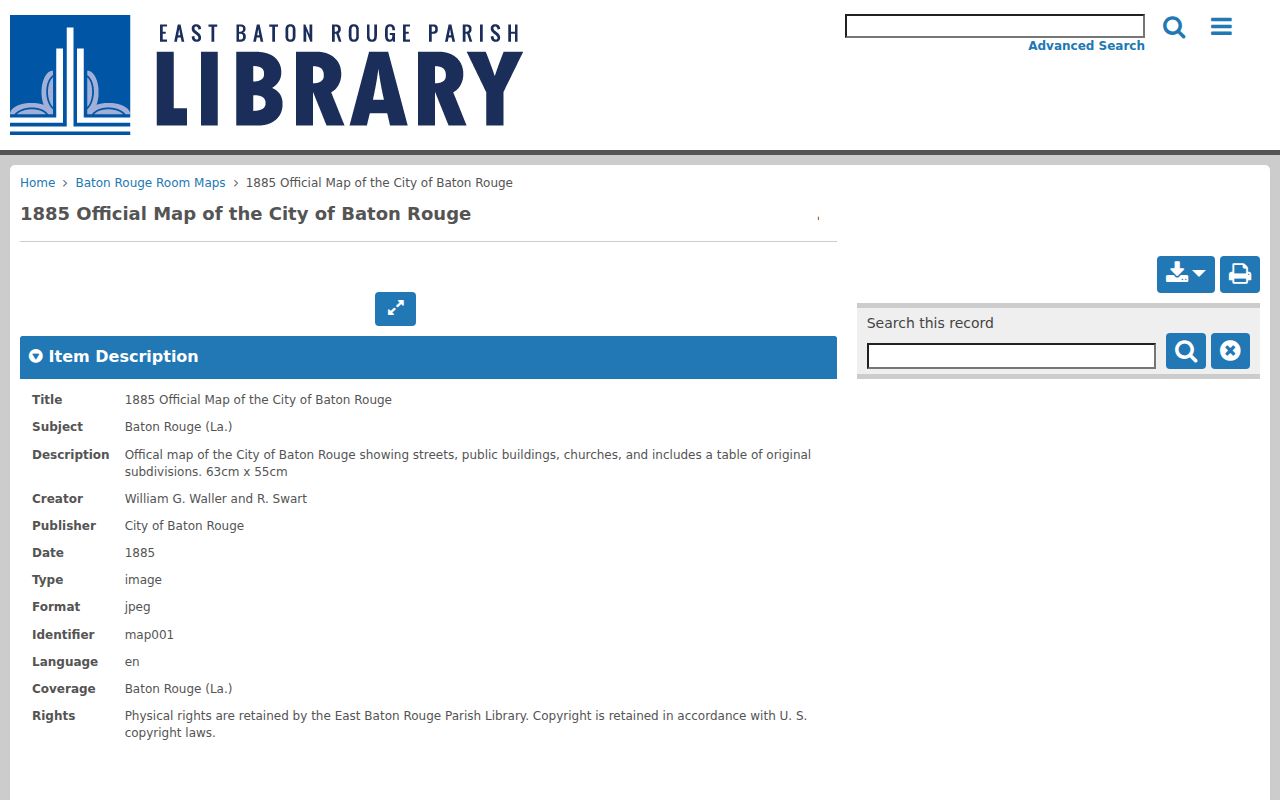
Compare its dated layout with a directory entry. Do not assume today's street grid is identical.
East Baton Rouge Past Households
Deeds name owners, not all occupants. The 1895 Baton Rouge City Directory can supply a name, occupation or business role, street address, and sometimes a separate residence notation. The first local directory was reported as 1888, and the 1895 scan is the fourth edition. Selected later years are held or searched through the parish library, LSU collections, and Louisiana State Archives. Collection details belong on the East Baton Rouge city directory page.
Pair a directory entry with the closest available federal census schedule. Search the surname and spelling variants, cite the volume year and page, and note each person in the household. Then compare the next directory year. A move, death, new job, or same-name collision may explain a change.
- Copy the directory address exactly, including the source year.
- Find the enumeration district and census image for the closest public census year.
- Compare names, ages, relationships, occupations, and nearby addresses.
- Return to adjacent directory years to bracket arrival and departure.
Lawful use. Research previous residents for house history, genealogy, heirs, or personal curiosity. Never use an address trail to track, harass, or harm a living person.
Obituaries Close Resident Gaps
The EBRPL obituary indexes cover decade groups from the 1940s through 1991. A dated obituary may connect a prior occupant with relatives, a church, funeral home, or last residence. Check the newspaper because an index is only a route to the notice.
Probate and succession records can explain how land passed after a death. Search the Clerk's probate index with the decedent's exact name and a tight date range. A judgment of possession may also appear in conveyance records. Diocese of Baton Rouge archives offer appointment-based research in sacramental, parish, school, map, photo, and burial materials when a church clue appears.
Annexation Changes Previous Resident Trails
The City-Parish plan took effect in 1949 after Baton Rouge had expanded far beyond its older limits. Later annexations continued through 2018. Those shifts can change the municipal label, tax context, map description, and office attached to a dated address without moving the building.
The official annexation history documents that sequence.
Use the annexation date to decide whether to search Baton Rouge, another municipality, or parish records. Postal city wording alone does not settle historic jurisdiction.
Cite Every Previous Resident Finding
A useful conclusion states what the source proves and when. Record the office, collection title, publication or record date, volume and page, item ID, query date, and image or copy status. Keep physical address, mailing address, and legal description separate. If two sources conflict, retain both dates instead of forcing one undated answer.
Previous residents can be placed at an address only as strongly as the underlying item allows. A directory is dated presence, a tax roll is an assessment link, and a deed is a recorded transfer. Together they form a defensible history. None alone proves that a person occupied the property every day of that year.